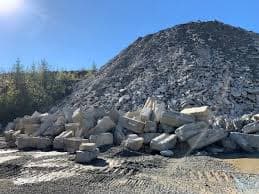
Best Gravel for Standing Water in a Yard: Drainage Guide
Standing water in a yard isn't a gravel problem until you know it's a gravel problem. Dump the wrong stone on a boggy spot and a year from now you'll have a wet lump of rock.
This guide helps you diagnose the water first, then pick the right aggregate to move it somewhere useful.
Diagnose the Water Before You Buy Anything
Three very different problems look like "a wet spot in the yard." The fix is different for each.
1. Surface Runoff
Water is rolling downhill and sitting in a low spot.
Test: After a rain, watch where water enters. If it's coming from a slope, driveway, downspout, or neighbor's yard, it's runoff.
Fix: Intercept uphill with a French drain or swale and route it away.
2. High Water Table
Groundwater is close to the surface. Common in low-lying areas and at the bottom of bowl-shaped lots.
Test: Dig a 24" hole in a dry stretch. If it fills on its own within a day or two, the water table is high.
Fix: Gravel alone won't lower a water table. Raise the area with fill or manage surface water so you're not adding to the load.
3. No Percolation (Clay Soil)
The soil below refuses water. East Tennessee red clay drains at a rate best measured in weeks.
Test: Fill a 12" hole with water. Drains in a few hours = fine. Still there the next day = clay.
Fix: Excavate and install a gravel infiltration bed or a dry well that daylights to a lower elevation.
Why the Right Gravel Matters
Coarse angular stone drains. Small round smooth stone does not.
- Angular stone locks together with consistent void space between the pieces. Water flows through the voids.
- Rounded stone (pea gravel, river rock) packs tighter over time, and the smooth faces let fines fill the gaps. In two seasons your "drainage" bed is a lump.
- Fines are the enemy. Any dust or unwashed screening migrates into the voids and shuts down flow.
Clean, washed, angular, and sized 3/4" to 1-1/2" is the drainage sweet spot.
Best Gravel Options for a Wet Yard
Option 1: #57 Crushed Stone (The Workhorse)
The default for almost every residential wet-yard fix.
Specs:
- Size: 3/4" to 1"
- Shape: Angular (crushed limestone or granite)
- Fines: None (washed)
Pros:
- Great drainage-to-coverage balance
- Surrounds a 4" perforated pipe cleanly
- Easy to shovel and rake
- Widely stocked
Cons:
- Costs more than crusher run (but crusher run doesn't drain)
Best for: French drains, dry wells, foundation drains, standard yard drainage beds
Option 2: #4 or #3 Larger Crushed Stone
Golf-ball to fist-sized clean stone. Reach for it when the base of the trench or pit sits in wet soil.
Specs:
- Size: 1-1/2" to 2-1/2"
- Shape: Angular
- Fines: None
Pros:
- Maximum void space, maximum flow
- Great as a bottom "reservoir" layer under #57
- Won't clog even if some soil migrates in
Cons:
- Awkward under a pipe (big gaps)
- Not ideal by itself as the top layer
Best for: Bottom base of a dry well, very wet trench floors
Option 3: Recycled Concrete Aggregate (RCA)
Crushed concrete screened to the same 3/4" size as #57. The budget drop-in.
Specs:
- Size: 3/4" (screened)
- Shape: Very angular
- Fines: Spec "clean" or "washed"
Pros:
- Meaningfully cheaper than virgin stone
- Performs as well as new limestone in drainage
- Keeps concrete out of the landfill
Cons:
- Color varies (gray)
- Unscreened RCA can carry fines
Best for: Budget French drains, dry well fill, foundation drain backfill
What NOT to Use
- Pea gravel. Smooth, round, small. Packs tight and traps fines. The most common mistake.
- River rock. Same problem as pea gravel at bigger sizes and higher prices. Decorative only.
- Sand. Fills every void. Water will not move through it.
- Crusher run / dense grade. The fines that make it compact are the feature, and they kill drainage.
- Topsoil "to level it out." You've made a bigger sponge.
Two Solutions and the Stone Each One Needs
The French Drain
A gravel-filled trench with a perforated pipe at the bottom, sloped 1% (about 1" of drop per 8 feet) toward a lower outlet.
- Trench: 6-12" wide, 18-24" deep
- Line with filter fabric
- 2-3" of #57 on the bottom
- 4" perforated pipe, holes facing DOWN
- Backfill with #57 to 3-4" below grade
- Fold fabric over the top, cap with topsoil
Use it when water is flowing in from a source you can identify. Our French drain aggregate guide goes deeper on stone selection.
The Dry Well (Infiltration Pit)
A gravel-filled pit that holds water underground long enough for the surrounding soil to accept it.
- Pit: 3-4 ft wide, 3-4 ft deep (sized to the water volume)
- Line with filter fabric
- Bottom layer: 6-12" of #4 stone (the reservoir)
- Fill the rest with #57
- Fold fabric over, cap with topsoil
Use it when there's nowhere lower to daylight a French drain to, but the surrounding soil eventually accepts water.
How Much Gravel Do You Need?
For a trench or a rectangular pit, it's the same formula:
(Width in ft × Depth in ft × Length in ft) ÷ 27 = Cubic Yards Cubic Yards × 1.4 = Tons
Add 10% for settling.
Quick Estimate Table
| Job | Dimensions | Stone Needed |
|---|---|---|
| 25 ft French drain | 12" × 24" × 25 ft | ~1.9 cy / ~2.6 tons |
| 50 ft French drain | 12" × 24" × 50 ft | ~3.7 cy / ~5.2 tons |
| Small dry well | 3 ft × 3 ft × 4 ft | ~1.3 cy / ~1.9 tons |
| Large dry well | 4 ft × 4 ft × 4 ft | ~2.4 cy / ~3.4 tons |
Rough Cost Comparison
| Material | Relative Cost | Notes |
|---|---|---|
| #57 crushed stone (virgin) | Middle | The default choice |
| #4 larger drainage stone (virgin) | Middle to higher | Reservoir base layer |
| RCA #57 (recycled concrete) | Usually lowest | Same drainage as virgin #57 |
| Pea gravel | Higher | Don't. |
Prices vary by supplier, delivery distance, and load size. For current RCA #57 pricing and delivery from SMSG, call (865) 999-0857 before you build a budget around a number. For more on tonnage math, see our tons vs cubic yards guide.
Common Mistakes That Ruin the Fix
- Pea gravel. Rounded stone plus fines equals a rock sponge.
- Skipping filter fabric. Soil migrates in and the bed clogs within a season.
- Undersizing. A 4" deep gravel bed is landscaping, not drainage. Go 18-24" minimum.
- No slope. A flat French drain is a long, skinny puddle.
- Discharging into another low spot. You've moved the wet spot 30 feet, not fixed it.
- Perforated pipe holes facing up. Water enters from the bottom. Holes down.
The Short Version
Diagnose the water. Buy clean angular stone in the 3/4" to 1-1/2" range. Skip anything round, smooth, or full of fines. Wrap the bed in filter fabric and give the water somewhere lower to go.
If you get those four things right, the wet spot goes away and stays gone.
Need drainage stone for your project? Smoky Mountain Sand & Gravel sells RCA #57, clean recycled concrete stone with no fines, to homeowners and contractors throughout Blount County, Maryville, Alcoa, and surrounding East Tennessee communities. We don't sell virgin stone or pea gravel. See our aggregate for sale page, and call us at (865) 999-0857 for current pricing and delivery.
Frequently Asked Questions
What is the best gravel for standing water in a yard?
Clean, washed, angular stone in the 3/4 inch to 1-1/2 inch range, like #57 or RCA #57. Skip pea gravel and river rock, which pack tight and trap fines.
Can I just spread gravel on top of the wet spot?
No. You'll get a gravel-topped wet spot. Gravel needs void volume below grade, in a French drain or dry well, to hold and move water.
How deep should a French drain trench be?
18 to 24 inches for most residential yards. Go deeper if the water source, like a foundation, slope, or spring, is deeper.
Do I need a perforated pipe, or is gravel alone enough?
Gravel alone works for a short infiltration bed. Anything longer than about 10 feet, a perforated pipe moves water much faster and is worth it.
Is RCA as good as new limestone for drainage?
Yes. Clean RCA #57 is angular and the same size, so it drains the same. Call SMSG at (865) 999-0857 for current pricing.
Related Guides
Ready to get started?
Serving Blount County, Knox County, and the greater East Tennessee region. Mon-Fri 7am-5pm, Saturday 8am-12pm.