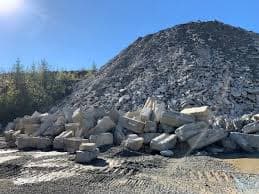
Best Materials for a Paver Patio Base: Selection Guide
A paver patio is only as good as what's underneath it. Wrong base and you get sinking pavers, cracked joints, and frost heave every winter. Right base and the surface stays flat for 25+ years.
This guide helps you pick the right base material for your paver project.
Why the Base Matters
The pavers are the easy part. What sits under them decides whether the surface lasts. A proper base does three jobs:
- Drainage: moves water away before it saturates the sub-grade
- Load distribution: spreads foot (or vehicle) traffic so pavers don't rock
- Frost protection: compacted, drained stone doesn't hold water that heaves in freeze-thaw winters
Skip any of these and the patio moves.
Best Base Material Options
Option 1: Crusher Run (Dense-Grade), Recommended
Also called: DGA, road base, 3/4" minus, dense-grade
Pros:
- Compacts to a nearly rigid slab
- Fines fill voids for maximum density
- Handles pedestrian AND light vehicle loads
Cons:
- Not permeable, must be pitched for drainage
- Wrong choice for permeable paver systems
Best for: Standard interlocking paver patios, walkways, driveways
Option 2: Recycled Concrete Aggregate (RCA)
Same 3/4" minus gradation as virgin crusher run, made from crushed concrete.
Pros:
- Usually cheaper than virgin dense-grade
- Compacts as hard or harder than limestone
- Environmentally sustainable
Cons:
- Variable color (grey with occasional rebar-red flecks)
- Buy from a reputable yard to avoid debris
Best for: Budget-conscious builds, driveway bases where extra depth adds up fast
Option 3: #57 Stone (Permeable Applications ONLY)
Washed 3/4" to 1" angular stone, no fines.
Pros:
- Water passes straight through
- Required for permeable paver systems
- No frost heave
Cons:
- Will NOT work under standard sand-set pavers: too much void space, pavers rock
- Requires open-graded bedding and joint stone above it, not sand
Best for: Permeable paver installations, stormwater projects
Option 4: Stone Dust / Concrete Sand (Setting Bed, NOT the Base)
These go ON TOP of the compacted base as a 1" bedding layer. They're what the pavers sit on. People confuse this constantly.
Pros:
- Screeds to a perfect flat surface
- Concrete sand is the ICPI-recommended standard
Cons:
- Zero structural value alone
- Cannot substitute for a compacted stone base
Best for: The 1" setting layer between compacted base and pavers
What NOT to Use
Pea Gravel / River Rock: rounded shape can't lock up. Pavers rock forever.
Unwashed Fill Dirt: clay and organics hold water, heave in winter, settle unpredictably.
Play Sand: rounded grains wash out through joints.
Anything Organic: mulch, topsoil, wood chips rot and subside.
How Much Base Do You Need?
Standard spec:
- 4" compacted base for pedestrian patios
- 6-8" compacted base for driveway pavers
- Plus a 1" setting bed of concrete sand on top
Quick Estimate (4" Compacted Base)
| Patio Size | Cubic Yards | Approx Tons |
|---|---|---|
| 10' x 10' | 1.5 cy | 2 tons |
| 12' x 16' | 2.8 cy | 4 tons |
| 15' x 20' | 4.5 cy | 6.5 tons |
| 20' x 25' | 7.5 cy | 10.5 tons |
Formula:
(Sq Ft × Depth in Inches) ÷ 324 = Loose Cubic Yards Loose Cubic Yards × 1.4 = Tons
Order 15-20% extra. Crusher run compacts down about 25% under a plate compactor.
Installation Sequence
- Excavate 7-8" below finished paver height, 6-8" wider than the patio on all sides
- Geotextile fabric across the sub-grade (mandatory over clay soil)
- Crusher run in 2" lifts, plate-compact each with 2-3 passes, until you hit 4" (or 6") compacted depth
- Screed a 1" concrete sand setting bed dead flat. Do NOT compact it
- Set pavers directly on the sand with consistent joint spacing
- Edge restraint spiked into the compacted base around the perimeter
- Sweep joint sand (polymeric preferred), then compact with a plate compactor and rubber pad
Rough Cost Comparison
| Material | Relative Cost | Role |
|---|---|---|
| Crusher run (virgin) | Middle | Structural base |
| RCA crusher run (recycled) | Usually lowest | Structural base (budget) |
| #57 stone (washed) | Middle to higher | Permeable base only |
| Concrete sand | Middle | 1" setting bed |
Prices vary by supplier and delivery distance. For current RCA pricing from SMSG, call (865) 999-0857.
For most residential patios, RCA base + concrete sand bed is the sweet spot: real savings on the biggest quantity of material without sacrificing performance.
Common Mistakes
- Skipping compaction: dumped loose stone sinks for years
- Compacting one thick lift instead of thin ones: the bottom half stays loose
- Using #57 stone under standard pavers: pavers rock forever
- No geotextile over clay: clay pumps up through the stone
- Too-thin base for the load: 4" won't hold a truck; driveways need 6-8"
- No edge restraint: the whole assembly walks outward and joints open
Thin lifts matter. Dump 6" at once and the bottom stays fluffy, which is where the patio fails from. Our aggregate compaction guide covers lifts, moisture, and passes in detail. Need to figure tonnage? Use the calculator or our how much gravel do I need guide.
What To Use
For a standard interlocking paver patio: 4-6" of compacted crusher run (virgin or recycled), a 1" concrete sand setting bed, and polymeric joint sand. That assembly lasts decades.
The biggest thing homeowners get wrong isn't the material choice. It's the compaction. Rent the plate compactor, run it in 2" lifts, and the base will outlive the pavers on top of it.
Need base material for your patio project? Smoky Mountain Sand & Gravel sells RCA crusher run (3/4" minus with fines, compacts hard) for paver base and RCA #57 for permeable systems throughout Blount County, Maryville, Alcoa, and the surrounding East Tennessee communities. See our aggregate for sale page. We're open Monday through Friday 7 AM to 5 PM and Saturday 8 AM to noon. Call us at (865) 999-0857 for current pricing and delivery.
Frequently Asked Questions
What is the best base material for a paver patio?
Compacted crusher run (dense-grade), virgin or recycled, 4 to 6 inches thick, topped with a 1 inch concrete sand setting bed.
Can I use crushed concrete instead of virgin crusher run?
Yes. RCA crusher run compacts as hard as virgin dense-grade for residential paver base and usually costs less. Call SMSG at (865) 999-0857 for current pricing.
Can I use #57 stone under pavers?
Only for permeable paver systems with open-graded bedding. Under standard sand-set pavers, #57 has too much void space and the pavers rock.
What if I have clay soil underneath?
Put geotextile fabric between the subgrade and base stone, and go a little deeper, 5 to 6 inches of compacted base instead of 4.
How thick does the base need to be for driveway pavers?
Minimum 6 inches compacted, and 8 inches is safer for anything a truck will park on.
Can I use crusher run for the setting bed too?
No. The 1 inch bedding layer needs screedable concrete sand. Crusher run has too many chunks to screed flat.
Related Guides
Ready to get started?
Serving Blount County, Knox County, and the greater East Tennessee region. Mon-Fri 7am-5pm, Saturday 8am-12pm.