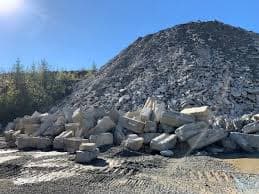
Do I Need to Separate Rebar from Concrete Before Dumping?
Short answer: no, you don't need to separate rebar from concrete before dropping it at SMSG. We pull the steel during processing. Bring the slab as it broke.
That said, this question comes up constantly, and it comes up because most concrete demo jobs generate reinforced pieces where rebar is sticking out or embedded through the middle. Here's what you actually need to know before you load up.
Why We Take Rebar-Laced Concrete
Our processing line runs broken concrete through a jaw crusher and then over a magnetic separator before the crushed material hits the screen deck. The magnet pulls steel (rebar, mesh, chair spacers, embedded conduit ties) out of the stream and drops it into a scrap bin. That scrap goes to a metal recycler.
What comes off the screen deck is clean recycled crushed aggregate (RCA) at the size we're producing that day. The steel goes to its own recovery stream. You don't need to do the separation yourself.
This is standard for any real concrete recycling operation. If a yard tells you they can't take rebar-laced material, they probably don't have magnetic separation and they're not a true recycler.
What "Rebar in Concrete" Actually Means
We're talking about:
- Sidewalk mesh (welded wire fabric embedded in a 4-inch slab)
- Rebar cages in footings, walls, retaining walls, columns
- Individual rebar rods running through slabs, patios, or driveways
- Post-tension cables (with caution, see below)
- Chair spacers, ties, and embedded metal
All of the above are fine. The magnetic separator doesn't care about grade or size. Rebar, mesh, chairs, ties, they all get pulled.
The One Exception: Post-Tension Cable
Post-tension slabs are a different animal. Post-tension cables run under load. When you cut them without releasing tension, they can snap and take a chunk of anything in the way with them. This is a jobsite safety issue, not a recycling issue.
If you're demoing a post-tension slab (common in commercial buildings and some high-end residential), the tension needs to be released before or during demolition by a qualified crew. Once the cables are cut and relaxed, the resulting broken concrete with cable stubs is fine to bring to us. We'll pull the steel like anything else.
If you're not sure whether the slab you're tearing out is post-tension, don't guess. Have the structural drawings or a demolition contractor look at it first.
What You Can Skip Doing Before You Come
Save yourself the labor. You don't need to:
- Cut rebar flush with the concrete surface
- Break slabs into rebar-free pieces
- Pull mesh out of sidewalk pieces
- Grind chair spacers off footings
- Bend rebar back into the concrete
Bring the pieces as they broke. Longer sticking-out rebar is actually easier to load because it gives you something to grip when you're stacking pieces in the bed or trailer.
What Still Matters
A few things do still matter, rebar or not.
Piece size. Nothing bigger than 2 by 2 feet as a general rule. Oversize pieces are hard to load, hard to unload, and hard to feed through the crusher. If you've got slabs bigger than that, break them down at the jobsite with a sledge or a demo saw. Ten minutes at the site saves an hour at the yard.
Load weight. Concrete is 4,000 pounds per cubic yard. Rebar adds maybe 5 to 10 percent on top of that for typical reinforcement density. Don't overload your truck. See the full truck loading guide for legal payload by truck class.
Cleanliness. Rebar is fine. Wood forms, form ties, insulation, foam, and drywall are not. If you're breaking out a foundation that has the sill plate or insulation stapled on, pull that off before you load. Otherwise the load reads as mixed C&D and we may have to turn it away.
Loading Reinforced Chunks Safely
Rebar sticking out changes how you load. Two things to watch:
Sharp ends. Rebar cut ends can slice tires, hoses, and hands. Load pieces so the cut ends face down or center-in, not out toward you or the truck sides. If you've got a lot of protruding rebar, wear cut-resistant gloves during load and unload.
Interlocking. Reinforced pieces tend to hook into each other, which is actually helpful in transit (less shifting) but painful when you're trying to unload one piece at a time. Load with intention: biggest flattest pieces on the bottom, medium in the middle, small on top. When you unload, work from the top down.
Pricing: Free for Clean Loads
Clean concrete with rebar costs the same to drop at SMSG as any other clean concrete: nothing. No scale, no appointment, and no surcharge for steel. If the load is mixed with wood, trash, or dirt, call (865) 999-0857 before you haul.
Compare that to about $60 per ton at the Blount County Landfill. See the free concrete drop-off page, our concrete disposal cost guide, and the deeper dive on reinforced concrete demolition.
Ready to Drop Your Load?
Call (865) 999-0857 or drive to 245 Brookdale Rd, Maryville TN. Clean loads are free. Mon-Fri 7 AM to 5 PM, Saturday 8 AM to noon.
Frequently Asked Questions
Do I need to cut rebar out of my concrete before I bring it to SMSG?
No. We separate steel from concrete during processing with a magnetic separator. Bring the slab as it broke.
Do you charge extra for rebar-laced concrete?
No. Clean concrete with rebar or wire mesh drops off free, the same as plain concrete.
What about post-tension slabs?
Post-tension cables need to be released safely at the jobsite by a qualified crew before demo. Once released and cut, the broken concrete with cable stubs is fine to bring.
What if my load has mesh, chairs, and ties in it, not just rebar?
All fine. The magnetic separator pulls all ferrous metal, not just rebar.
Can I bring a whole footing with a full rebar cage?
Break it down to pieces no larger than about 2 by 2 feet at the jobsite first. The rebar cage inside those pieces is fine.
Related Guides
Ready to get started?
Serving Blount County, Knox County, and the greater East Tennessee region. Mon-Fri 7am-5pm, Saturday 8am-12pm.