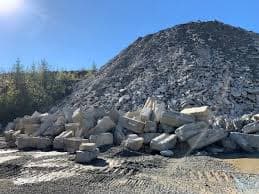
Aggregate Compaction: Lifts, Moisture, and Proctor Density
Ninety percent of the aggregate failures we see (pumping driveways, rutted parking pads, subsided road shoulders) trace back to the same handful of compaction mistakes. Wrong lift depth. Dry material dumped straight from the truck. A plate compactor doing work that needed a roller. Passes counted as one when they should have been three.
Compaction is boring, invisible, and buried. That's exactly why it's the piece that gets shortcuts, and exactly why those shortcuts show up 12-36 months later as a repair. This is the full picture: the numbers, the sequence, and the field-verification tricks that don't require a $6,000 nuclear density gauge.
What Compaction Actually Does
An uncompacted crushed-stone lift is roughly 60-65% solid material by volume. The rest is void: air, gaps between angular particles, spaces the roller hasn't yet pressed out. Water fills those voids the first time it rains, then leaves when the sun comes out, then fills them again. That cycle is what pumps and settles.
Compaction squeezes the voids out. A well-compacted crusher run lift is 90-95% solid, down under 10% air voids, which means:
- No more room for water to sit. What can't accumulate can't freeze, can't lubricate particles into moving, can't cycle.
- Load path stays put. A wheel load on compacted stone spreads through the material and dies in the subgrade. A wheel load on loose stone kneads particles around until you have a rut.
- Freeze-thaw stops being a wall-killer. The mechanism that jacks unfrozen builds apart is water expanding 9% by volume when it freezes. Squeeze out the water storage and the mechanism has nothing to work with.
Every number below serves one goal: get to that 90-95% density in a controlled, verifiable way. If you're still choosing a base material, read crusher run vs #57 for driveway base first.
The Compaction Sequence
Building any aggregate structure (driveway base, retaining wall backfill, road subbase, culvert bedding) follows the same order:
- Prep the subgrade
- Place aggregate in lifts of controlled depth
- Bring each lift to target moisture
- Compact with the right equipment, right number of passes
- Verify density before placing the next lift
Skip a step, cheat a number, and the failure mode is usually the same: uneven settling over the first two seasons, followed by pumping or rutting under load.
Step 1: Subgrade Prep
The best-compacted base in the world sits on top of whatever the subgrade will support. Proof-roll the subgrade first: run a loaded dump truck (or the compactor itself, wheels-first) across the graded native soil. Watch for spongy spots. Anywhere the tire leaves a print deeper than a half-inch, the soil isn't ready. That soft area gets excavated to firm bearing and backfilled in compacted lifts, same rules as the base.
For clay subgrades in East Tennessee (the norm from Blount County down to the Sequatchie Valley), moisture content matters here too. Clay compacted at 3-5% wetter than optimum won't hold density. Let it dry a day before rolling, or bring in a lime/cement treatment for larger jobs.
Once the subgrade is firm and passes a proof-roll with no rutting, you're ready to build up.
Step 2: Lift Depth
A lift is the depth of loose aggregate you place before compacting. Every roller and plate has a compaction depth limit. Force applied at the surface only reaches so far down before it dissipates. Placing lifts thicker than that limit means the bottom of the lift never really compacts, and you've built a soft layer under a hard one. When load arrives, the soft layer collapses and the hard shell cracks.
Rule-of-thumb lift depths in loose thickness (measure before compacting):
| Compactor Type | Max Lift Depth |
|---|---|
| Hand tamper / rammer (jumping jack, ~150 lb class) | 4-6 in |
| Plate compactor (200-500 lb class) | 6-8 in |
| Small vibratory smooth-drum roller (1-2 ton class) | 8-10 in |
| Standard vibratory smooth-drum roller (7-12 ton class) | 10-12 in |
| Padfoot / sheepsfoot roller (7-15 ton class, for cohesive soils) | 8-12 in |
For most residential and light-commercial concrete/aggregate work in East Tennessee (driveways, parking pads, shed foundations, retaining wall backfill), the compaction is happening with either a 300-500 lb plate compactor or a small ride-on roller. Keep lifts to 6-8 inches loose thickness for a plate, 8-10 inches for a small roller. If the design requires 18 inches of base, that's two lifts, not one dump-and-hope.
A 6-inch lift after compaction usually finishes at 4.5-5 inches, a loss of 15-25% depending on gradation. Plan the total number of lifts around finished, not loose, thickness.
Step 3: Moisture Content
This is the single most under-discussed compaction variable, and the one that separates jobs that pass QC from jobs that fail.
Every aggregate has an "optimum moisture content" (OMC): the moisture percentage by weight where compaction gives the highest density for the least effort. Compact drier and the particles resist being pushed together (there's no lubrication between grains). Compact wetter and the water can't escape fast enough, and you get "rubber base" where the material springs back under the roller.
Typical OMC ranges for East TN aggregate materials:
| Material | Optimum Moisture Content |
|---|---|
| #57 clean crushed stone (open-graded) | Not moisture-sensitive; drainage material, compacts by placement |
| #67 dense-graded crushed stone | 5-8% |
| Crusher run (TDOT Grade D or equivalent) | 6-9% |
| RCA (recycled concrete aggregate, crusher-run gradation) | 8-11% |
| Sandy loam subgrade | 10-14% |
| Clay subgrade | 15-22% |
Field test for optimum moisture on dense-graded aggregate: grab a handful of the material and squeeze it into a ball. If it holds shape when you open your hand but crumbles when you flick it with a finger, you're at or near OMC. If it stays a wet clump, too wet. If it won't form a ball at all, too dry, so add water.
On residential jobs, the practical version is: hose down each lift after placement before compacting. Not soaked, just visibly darkened. A garden hose with a fan spray, walking each lift at a normal pace, is usually about right. Bigger jobs use a water truck.
RCA is thirstier than virgin stone because the cement fines in the material absorb water. If you're compacting RCA in dry weather, add water more generously than you would for virgin crushed stone.
Step 4: Roller Passes and Compactor Type
How many passes is the right number of passes? Depends on the equipment, the lift, and the material. Rules of thumb:
- Plate compactor on 6-8 in dense-graded lift: 3-4 passes in each direction (so 6-8 total)
- Small vibratory roller on 8-10 in lift: 4-6 passes total
- Standard vibratory smooth-drum roller on 10-12 in lift: 6-8 passes total
- Padfoot roller on cohesive subgrade: 6-8 passes until the pad marks are barely visible ("walking out")
"Pass" means one lane of coverage in one direction. Back-and-forth counts as two. Overlap each pass by 6 inches so no strip is missed.
Vibration is the difference-maker. A 500 lb plate compactor with the vibrator running delivers roughly the same effective force as a 1,500 lb static roller. On dense-graded material, always use vibration. Most of the compaction work comes from the vibratory action, not the static weight. On open-graded materials like #57 stone, vibration will actually break down the angular corners and drop the drainage performance; use static-mode passes only, or none at all (open-graded material is placed in an already-dense arrangement and compacts to its final state under initial load).
The compactor is done when additional passes stop making a visible or measurable difference. This is called "reaching refusal." Once you get to refusal, more passes just polish the surface. They don't add density. Push past 2-3 passes at refusal and you can start breaking down the angular particles, which drops density.
Step 5: Density Verification
On commercial and DOT work, this is a nuclear density gauge job. A tech shoots each lift, prints numbers, files them for the QC report. Target on TDOT base course specs is typically 95% of the Modified Proctor maximum dry density (T-180) or 100% of Standard Proctor (T-99), depending on the spec.
On residential work, that gauge doesn't exist in the budget. Verify density with field methods:
The rubber-track test. Drive a wheeled or tracked machine (skid steer, tractor, loaded truck) across the compacted lift. Look for indent depth. Any track/tire mark under 1/4 inch across a full 6-inch lift usually indicates >90% compaction. Deeper prints mean underworked material.
The rebar drop test. Drop a 3-foot piece of #4 or #5 rebar point-down from waist height onto the compacted lift. On well-compacted crusher run or RCA it should stick in 1-2 inches. On loose material it drives 4-6 inches or hits until a hand stops it. Not a lab number, but repeatable across a site and useful for spotting soft zones.
The "walk it" test. Walk the lift heel-to-toe. On compacted material your heel doesn't sink. On underworked material you feel spring or slight give. This is the fastest check between rolls.
Rutting under first-load traffic. After the base is complete and the first truck of finish material crosses, look at the tire tracks. Tracks deeper than 1/2 inch on the finished base mean the base isn't done. Do more passes.
Any of these caught early saves a rip-out later. All of them together approximate what the nuclear gauge tells you, at zero cost and without a licensed operator.
What Failure Looks Like
Real failure modes we see on aggregate work in East Tennessee:
Pumping driveways in year 2. Water saturates a soft, undercompacted subgrade. Each wheel load kneads the base into the subgrade, then fines get pushed up into the base voids on rebound. The driveway "pumps": you can see water squeezing out around tire prints after a rain. Only cure is excavate and rebuild with proper subgrade prep + compacted lifts.
Rutted parking pads. Loose #57 or single-lift base thick enough to look done but never actually compacted below the top few inches. Wheel paths compress into ruts that fill with water and freeze.
Subsided retaining wall backfill. Backfill placed in one 24-inch lift instead of three 8-inch lifts. Wall stays vertical, but the ground behind slumps 4-6 inches over the first season. Then rain-water drops straight into the slump and finds the drainage stone by the long path, running along the wall face instead of down. Our retaining wall backfill guide covers doing it right.
Frost-heaved paths. Uncompacted or wet-compacted material in freeze zones. Ice lenses form in the voids, jack the surface up in winter, drop it in spring. Cracks along freeze-lines are diagnostic.
Each of these has the same root cause and the same fix: placement in the right lift depth at the right moisture, compacted with the right equipment for the right number of passes, verified before moving on.
Compaction by Material: Fast Reference
| Material | Best Compactor | Optimum Lift (loose) | Moisture Strategy | Passes to Refusal |
|---|---|---|---|---|
| Crusher run | Plate or vibratory roller | 6-8 in (plate) / 10-12 in (roller) | Hose to visibly dark, not saturated | 3-4 (plate) / 6-8 (roller) |
| Dense-graded RCA | Plate or vibratory roller | 6-8 in / 10-12 in | Water more generously than virgin stone | 4-5 (plate) / 6-8 (roller) |
| #57 clean stone | Static or hand tamp | 6-8 in max | None, dry-placed | 2-3 static passes only |
| #67 dense stone | Plate or vibratory roller | 6-8 in / 8-10 in | Light hose | 3-4 (plate) |
| Sandy/gravelly fill | Plate or vibratory roller | 6-8 in / 8-10 in | Just below OMC | 4-6 (plate) |
| Clay fill | Padfoot roller | 6-8 in | At OMC, ±2% | 6-8 padfoot passes until pad marks walk out |
When to Call an Engineer
DIY / contractor compaction works fine for:
- Residential driveways under 8 in total base
- Shed pads and patio bases
- Retaining wall backfill under 4 ft retained height
- Small parking pads for equipment or shop use
Bring in a licensed engineer with QC testing when:
- Commercial parking or drives with municipal inspection requirements
- Structural fills supporting a building foundation: the compaction spec is part of the structural drawings
- TDOT or municipal road work: nuclear density testing is code, non-optional
- Any lift over 12 inches in a single compaction pass: the design or the equipment is wrong
The Bottom Line
Compaction is the boring middle of every aggregate job, and it's where most residential failures come from. Get the four numbers right (lift depth, moisture content, roller passes, and density verification) and the base under your driveway, wall backfill, or shed pad will outlast the material.
Skip any one of them and you're building your own future repair job. And the repair costs 3-5x what the compaction would have.
Pick your base material and grab what you need in Maryville. We sell RCA crusher run (3/4" minus with fines, compacts hard) for base work and RCA #57 for the clean drainage layer. See the aggregate for sale page and call (865) 999-0857 for current pricing and delivery. Use the calculator to size your load. We're open Monday through Friday 7 AM to 5 PM and Saturday 8 AM to noon.
Frequently Asked Questions
How thick should each lift of gravel be when compacting?
Keep lifts to about 6 to 8 inches loose for a plate compactor and 8 to 10 inches for a small roller. Thicker lifts leave a soft layer at the bottom.
Should I wet gravel before compacting it?
Yes, for dense-graded material like crusher run or RCA. Hose each lift until it's visibly darkened but not soaked. RCA needs a bit more water than virgin stone.
How many passes does a plate compactor need?
On a 6 to 8 inch dense-graded lift, plan on 3 to 4 passes in each direction, or until extra passes stop making a difference.
Should #57 stone be compacted?
Not with vibration. #57 is open-graded drainage stone, so use a few static passes or a hand tamp at most. Vibration breaks down the angular corners.
How can I check compaction without a nuclear density gauge?
Use field checks: drive a loaded machine across and look for prints under 1/4 inch, do a rebar drop test, and walk the lift for spring or give.
Related Guides
Ready to get started?
Serving Blount County, Knox County, and the greater East Tennessee region. Mon-Fri 7am-5pm, Saturday 8am-12pm.