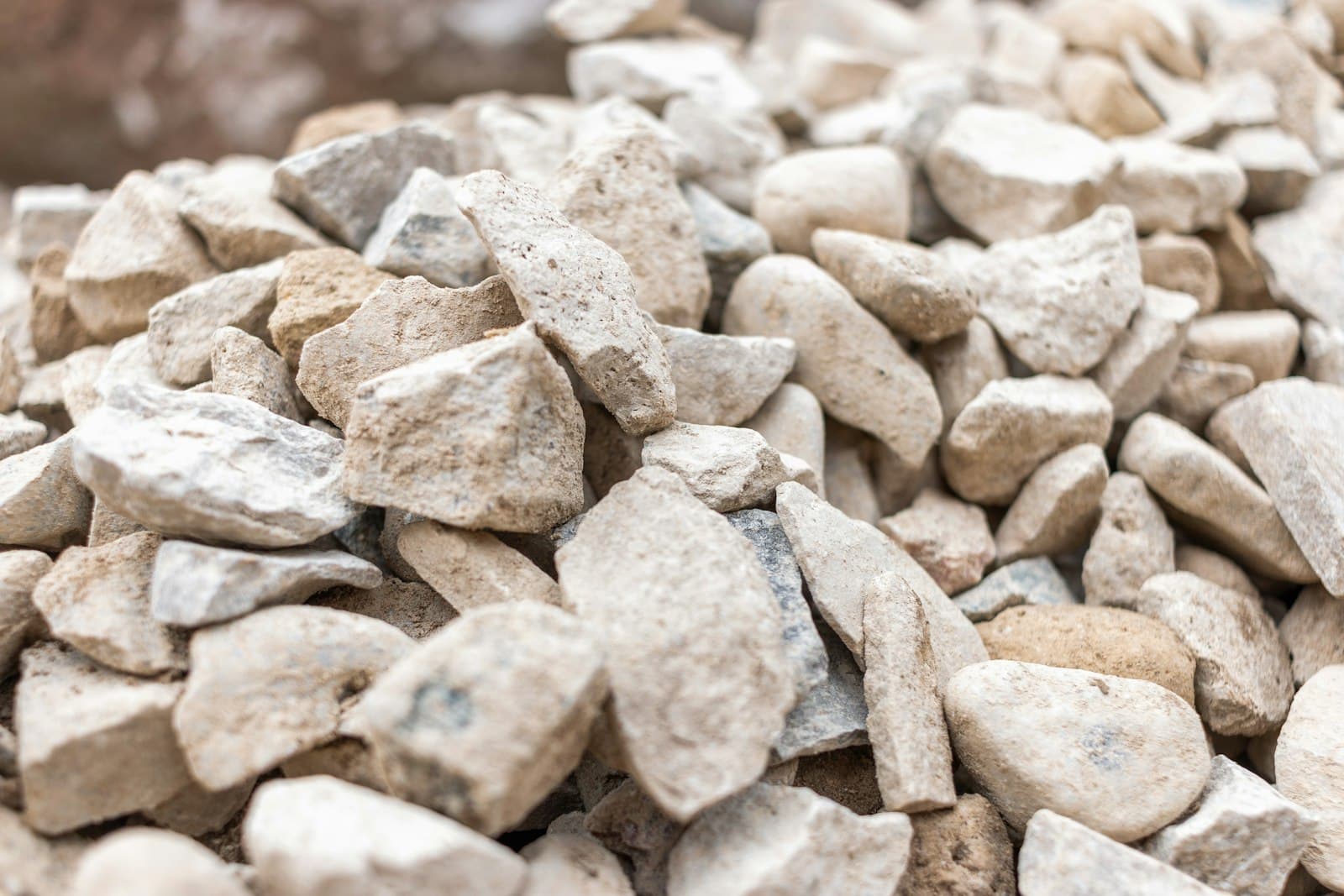
#57 Stone Under a Concrete Slab: Base Depth and Layers
Building in Blount or Knox County? We sell RCA #57 stone (recycled concrete) and virgin #57 for drainage and backfill. Pickup at our Maryville yard or delivery. Call (865) 999-0857 for pricing.
See RCA #57 stone →Quick answer: The standard gravel under a concrete slab is a 4 inch layer of clean #57 stone, often placed over compacted crusher run on soft or uneven ground. The #57 breaks capillary rise so ground moisture does not wick into the slab, drains any water that gets underneath, and gives the concrete uniform support. The vapor barrier goes on top of the stone, right under the concrete. Plate the #57 lightly before you pour. We sell recycled RCA #57 stone and RCA crusher run at our Maryville yard.
This post covers the under-slab layer only. For the general list of #57 jobs, see what #57 stone is used for. For sieve sizes and weights, see No. 57 stone specs.
Why put gravel under a concrete slab at all?
Three reasons, and #57 handles all three:
- Capillary break. Soil wicks moisture upward like a sponge. Fine material keeps that wicking going. Clean stone with big open voids stops it, so the slab does not stay damp from below.
- Drainage. Water that gets under a slab needs somewhere to go. A clean stone layer lets it move out instead of sitting against the concrete or softening the subgrade.
- Uniform support. Concrete cracks when one spot is soft and the next is hard. A stone layer evens out the bumps and gives the pour a consistent bed and thickness.
Pouring straight on dirt saves a little stone now and costs you in cracks, damp floors, and settling later.
How thick should the gravel base be?
Four inches is the common number for residential slabs: sheds, patios, garage floors, and basement floors. Some situations call for more:
| Situation | Typical base |
|---|---|
| Firm, well-drained subgrade | 4 in of #57 |
| Soft, clay, or uneven subgrade | 4 in compacted crusher run plus 4 in #57 |
| Wet site or high water table | 4 to 6 in #57, consider a perimeter drain |
| Basement floor | 4 in clean stone, vapor barrier on top |
| Garage with heavy vehicles | Compacted crusher run plus #57, thicker slab |
Check your local code. Building codes and plans often specify the base under a habitable space or garage. If an inspector or engineer gives you a number, use theirs.
#57 vs crusher run under a slab: which is better?
Each one is good at a different thing.
| Factor | #57 stone | Crusher run |
|---|---|---|
| Fines | Almost none | Yes |
| Capillary break | Excellent | Poor, fines wick moisture |
| Drainage | Excellent | Slow |
| Compaction | Settles and locks a little | Packs very hard in lifts |
| Support on soft ground | Good when confined | Excellent |
| Fine-grading before the pour | Harder, stones roll | Easy to screed flat |
There are three common ways to build it:
- #57 alone. Fine on firm, well-drained ground. Spread 4 inches, plate it lightly, and pour. Some crews "choke" the top with a thin layer of smaller stone or screenings so it is easier to walk on and grade flat.
- Crusher run alone. Strong support but no capillary break. Common under sheds and driveways, less ideal under a heated or finished space.
- Crusher run, then #57. Compact crusher run in lifts for support, then put #57 on top as the capillary break and drainage layer. This is the most forgiving build on mixed or soft East Tennessee clay.
Our crusher run vs #57 post covers how the two behave in general. The compaction guide covers lift thickness for crusher run.
Where does the vapor barrier go?
On top of the stone, directly under the concrete. The layer order from the bottom up:
- Undisturbed or compacted subgrade
- Compacted crusher run (if used)
- #57 stone, 4 inches typical
- Vapor barrier (poly sheeting, seams taped)
- Concrete
The vapor barrier stops water vapor. The #57 below it stops liquid water and capillary wicking. You want both under any slab that will be inside a heated space, under flooring, or in a basement. For an open patio or a shed slab, many builders skip the barrier, but the stone layer still helps.
Lay the barrier carefully so the stone does not puncture it. Patch any holes before the pour.
Do you need to compact #57 stone?
Lightly. #57 is close to self-consolidating. With no fines, there is not much for a compactor to squeeze together. But a couple of passes with a plate compactor does three useful things:
- Seats the stones so they lock against each other
- Knocks down high spots so the slab thickness stays even
- Gives you a firmer surface for workers and wheelbarrows during the pour
Do not try to "compact" #57 into a hard pack like crusher run. It will not get there, and that is fine. Its job is drainage and a capillary break. If you need hard support, that is what the crusher run under it is for.
What base for sheds, garages, patios, and basements?
Shed slabs. 4 inches of #57, or crusher run with #57 on top. Frame the pad so the stone does not spread. See gravel base for a shed and best gravel for a shed base.
Garage slabs. Compacted crusher run for support under vehicle loads, #57 on top, vapor barrier, then concrete. Follow the local code on slab thickness and base.
Patios. 4 inches of #57 works well, especially next to the house where you want water to move away from the foundation. A paver patio is a different build. See paver patio base materials.
Basements. Clean stone under the floor is standard, often tied into an interior drain system or sump. This is a critical drainage spot, so read the RCA note below.
Is recycled concrete #57 OK under a slab?
Yes. RCA #57 is angular, clean, and drains like virgin #57. Under a slab it gives the same capillary break and support.
Two notes. First, fresh RCA is slightly alkaline and can shed a little fine material and calcium early on. If the stone surrounds a perforated pipe in a critical drain, such as an interior basement drain to a sump, wrap the pipe in fabric or bed it in washed stone. For a plain under-slab layer, this is not a concern. Second, RCA #57 is for the base, not the mix. Do not use it as aggregate in the new concrete. More in what is RCA.
How many tons of #57 do you need under a slab?
Length times width gives square feet. Times depth in feet gives cubic feet. Divide by 27 for cubic yards. Our RCA #57 runs about 1.35 tons per cubic yard.
| Slab size | Area | RCA #57 at 4 in (tons) | With 10% extra |
|---|---|---|---|
| 10 x 10 patio | 100 sq ft | 1.7 | 1.8 |
| 10 x 12 shed | 120 sq ft | 2.0 | 2.2 |
| 12 x 16 shed | 192 sq ft | 3.2 | 3.5 |
| 20 x 20 garage | 400 sq ft | 6.7 | 7.3 |
| 24 x 24 garage | 576 sq ft | 9.6 | 10.6 |
| 30 x 40 shop | 1,200 sq ft | 20.0 | 22.0 |
If you are doing crusher run under the #57, figure that layer separately. Our gravel calculator handles any size and depth, and tons vs cubic yards explains the math.
Get slab base stone in Maryville
We sell RCA #57 stone and RCA crusher run, both made on site from clean recycled concrete. Pick it up at the yard or schedule delivery to the job. Pouring a slab where an old one used to be? We take the broken concrete free when it is clean. See free concrete drop-off.
- Address: 245 Brookdale Rd, Maryville TN 37801
- Phone: (865) 999-0857, call for current pricing
- Hours: Mon-Fri 7 AM to 5 PM, Sat 8 AM to noon
Frequently Asked Questions
Should I put #57 stone under a concrete slab?
It is a good choice for most slabs. A 4 inch layer of #57 breaks capillary rise from the ground, drains water away, and gives the concrete an even bed. Many builders put it over compacted crusher run.
How thick should the gravel be under a slab?
Four inches is the common minimum for sheds, patios, garages, and basements. Soft or wet ground may need more, and your local code or plans may set a different number.
Is crusher run or #57 better under a slab?
Crusher run packs harder and gives better support on soft ground. #57 drains and stops moisture wicking. The best base on many jobs is both: compacted crusher run with a layer of #57 on top.
Does the vapor barrier go above or below the gravel?
Above. The usual order is subgrade, crusher run if used, #57 stone, vapor barrier, then concrete. That keeps the stone below the barrier as a capillary break.
Do you need to compact #57 stone under a slab?
Lightly. #57 settles into place mostly on its own, but a couple of passes with a plate compactor seats the stones and gives you a flat, firm surface to pour on.
How much #57 stone do I need for a 12 x 16 slab?
At 4 inches deep, about 3.2 tons of RCA #57, or about 3.5 tons with 10 percent extra for waste and uneven ground.
Can recycled concrete #57 go under a new slab?
Yes. RCA #57 is a common base material under slabs and works the same as virgin #57 for drainage and support. It is not meant for mixing into the new concrete itself.
Related Guides
Ready to get started?
Serving Blount County, Knox County, and the greater East Tennessee region. Mon-Fri 7am-5pm, Saturday 8am-12pm.